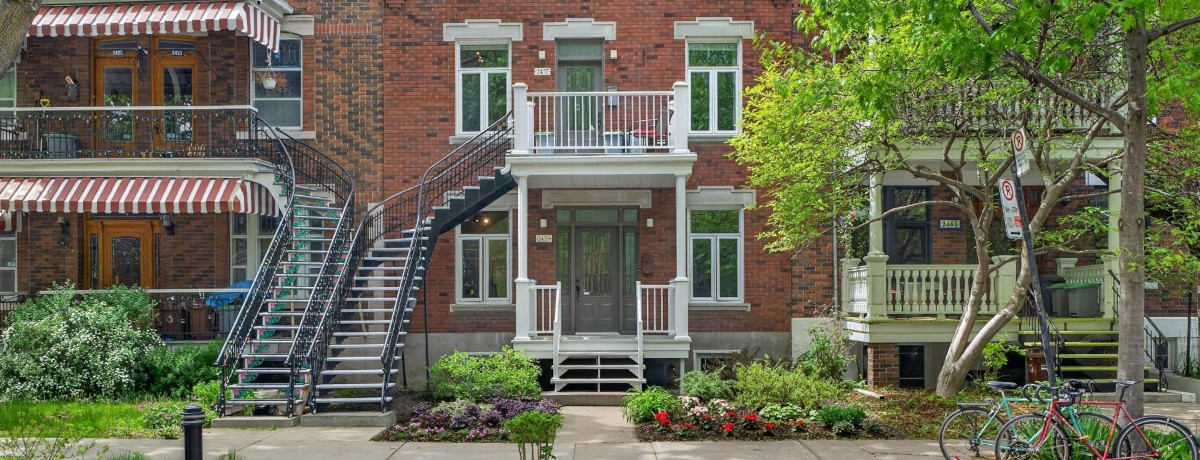
Buying a duplex in Montreal can be an attractive way to enter the real estate market, generate rental income, and build long-term equity. For an owner-occupant, a duplex can also provide a unique opportunity to reduce the effective cost of living by renting out one of the units.
But is buying a duplex in Montreal actually profitable?
The answer depends on much more than the property's purchase price and monthly rent. Financing costs, property taxes, insurance, maintenance, vacancy, renovations, tenant regulations, and the condition of the building all affect the investment's performance.
A duplex that looks inexpensive on paper can become an expensive investment if major repairs are required or rental income is significantly below market potential. Conversely, a well-located duplex with reasonable operating costs and stable tenants can provide both immediate rental income and long-term appreciation.
This guide explains how to evaluate a Montreal duplex, how rental income affects financing, the advantages and disadvantages of owning a duplex, and what buyers should consider before making an offer.
Best Areas in Montreal for Real Estate Investment
What Is a Duplex?
A duplex is a residential property containing two separate dwelling units within the same building.
In Montreal, duplexes are particularly common in established neighbourhoods and can take several forms. The owner may occupy one unit while renting the other, or both units may be rented to tenants.
For an investor, this creates two potential sources of return:
- Rental income generated by the property.
- Appreciation in the value of the property over time.
For an owner-occupant, there is an additional benefit: living in one unit while having a tenant contribute toward the property's expenses.
This is sometimes called "house hacking," although the concept is particularly well established in Montreal's traditional duplex and triplex market.
Why Are Montreal Duplexes Attractive to Buyers?
Montreal duplexes offer several characteristics that can make them appealing compared with purchasing a single-family home or condominium.
Rental Income
The most obvious advantage is rental income.
If you purchase a duplex and live in one unit, the rent from the second unit can help offset your mortgage, property taxes, insurance, and maintenance costs.
For example, imagine a duplex where the owner occupies one unit and rents the second for $1,800 per month.
That represents $21,600 in gross annual rental income.
The rent does not make the property free, but it can substantially reduce the owner's effective housing costs.
Building Equity
Every mortgage payment generally consists of both interest and principal.
The principal portion increases your equity in the property.
At the same time, if the property appreciates over the long term, your equity can increase further.
This combination of rental income, mortgage principal repayment, and potential appreciation is one of the main reasons investors consider Montreal duplexes.
Greater Control Than a Condo
Owning a duplex generally gives you more control over the building than owning a condominium.
You are not dealing with a condominium syndicate, common expenses, or rules governing a shared building in the same way.
However, that additional control comes with additional responsibility. The owner is generally responsible for maintaining the building, including the roof, exterior, structure, plumbing, heating systems, and other major components.
How Much Down Payment Do You Need for a Duplex?
The required down payment depends on how the property will be financed and whether you will occupy one of the units.
For an owner-occupied two-unit property, mortgage insurance rules can make financing significantly different from financing a purely investment property.
CMHC's current rental-income guidance allows up to 100% of gross rental income to be considered for qualification for an owner-occupied two-unit property under applicable mortgage insurance rules.
By contrast, CMHC's Income Property program for non-owner-occupied two-to-four-unit properties requires a minimum 20% equity contribution and permits financing up to 80% of the property's value, subject to the program's other eligibility requirements.
This distinction is extremely important.
A buyer planning to live in one unit may have access to financing options that are not available to an investor purchasing a duplex strictly as a rental property.
Your lender or mortgage professional should confirm the exact requirements based on your income, credit profile, purchase price, property type, and intended occupancy.
How Much Down Payment You Need in Quebec
How Does Rental Income Affect Mortgage Qualification?
Rental income can make a significant difference when purchasing a duplex.
Lenders do not necessarily treat rental income in the same way as employment income. The amount that can be included in your mortgage qualification depends on the financing program and whether the property is owner-occupied.
CMHC currently provides different approaches to rental income depending on the property and financing situation. For an owner-occupied two-unit property, up to 100% of gross rental income may be used under the applicable approach.
For non-owner-occupied two-to-four-unit properties under CMHC Income Property, lenders can use up to 50% of gross rental income or a net rental income approach.
This is why a buyer should speak with a mortgage professional before assuming that a property's rental income will automatically make the property affordable.
How Do You Calculate Whether a Montreal Duplex Is Profitable?
The easiest mistake to make is to compare the monthly rent with the monthly mortgage payment and call the difference "profit."
Real estate investment does not work that simply.
You should calculate the property's gross income, operating expenses, financing costs, capital expenditures, and potential vacancy.
Start With Gross Rental Income
Calculate the annual rent from all units.
For example:
- Unit 1: $1,800 per month
- Unit 2: $1,800 per month
- Gross annual rent: $43,200
If you live in one unit, however, the rent from your own unit is not rental income. Instead, you should compare the rent from the other unit with the cost of owning the entire property.
Subtract Operating Expenses
Typical expenses can include:
- Municipal taxes.
- School taxes.
- Property insurance.
- Utilities paid by the owner.
- Maintenance.
- Repairs.
- Snow removal.
- Landscaping.
- Professional services.
- Vacancy allowance.
Montreal's property assessment roll provides the basis for municipal taxation, but the assessment value should not be treated as the market value of the property. The City notes that property assessments consider factors including location, lot size, building size, age, construction quality, and income generated by the property.
Don't Forget Capital Expenditures
A duplex may require expensive work that does not occur every year.
Examples include:
- Roof replacement.
- Masonry repairs.
- Foundation work.
- Windows.
- Plumbing.
- Electrical upgrades.
- Heating systems.
- Exterior renovations.
A property can have positive monthly cash flow while still being a poor investment if a major capital expense is approaching.
A Simple Duplex Example
Consider a hypothetical Montreal duplex purchased for $700,000.
Suppose the second unit rents for $1,800 per month, producing $21,600 in annual gross rental income.
Now assume the owner has annual expenses of:
- $5,000 in municipal and school taxes.
- $1,800 in insurance.
- $1,500 in maintenance.
- $1,000 in utilities and other costs.
- $1,000 provision for vacancy and unexpected expenses.
That leaves approximately $11,300 before financing costs.
This does not necessarily mean the property is "profitable" in the traditional cash-flow sense.
The owner still has mortgage payments and other ownership costs.
However, the investment may still make financial sense because part of the mortgage payment builds equity, the tenant contributes toward the property's expenses, and the property may appreciate over time.
This distinction between cash flow and overall investment return is extremely important.
What Makes a Montreal Duplex a Good Investment?
Not every duplex is equally attractive.
Location
Location is one of the most important factors.
Look for areas with:
- Strong rental demand.
- Access to public transportation.
- Nearby schools.
- Shops and services.
- Employment opportunities.
- Parks and recreational facilities.
- Low vacancy.
A property in an excellent location can be easier to rent and potentially more resilient during weaker market conditions.
Best Neighborhoods in Montreal for Buyers
Layout
The layout of both units matters.
A desirable two-bedroom apartment may command significantly more rent than an awkwardly configured unit.
Private entrances, outdoor space, parking, storage, natural light, and laundry facilities can also affect rental demand.
Building Condition
A lower purchase price is not necessarily a bargain.
Before buying, investigate:
- The roof.
- Foundation.
- Masonry.
- Windows.
- Electrical system.
- Plumbing.
- Heating.
- Insulation.
- Drainage.
- Exterior maintenance.
A professional building inspection can help identify problems that are not immediately visible.
Existing Rents
Never assume that current rents can immediately be increased to market rent.
Quebec has specific rules governing residential leases and rent increases.
Since January 1, 2026, significant regulatory changes have affected the calculation of rent increases, and the Tribunal Administratif du Logement provides a specific calculation tool for applicable cases.
If you are buying a duplex with existing tenants, review the leases, current rents, payment history, and applicable rental rules before making assumptions about future income.
What Are the Risks of Buying a Duplex?
Duplex ownership can be rewarding, but it is not passive investing.
Tenant Risk
A tenant may leave unexpectedly, stop paying rent, or require additional management.
The landlord is also responsible for maintaining the rental unit in a condition suitable for habitation and must comply with Quebec's residential tenancy rules.
Maintenance Risk
Older Montreal duplexes can require substantial maintenance.
A building that looks attractive during a showing may still have expensive structural, roofing, masonry, plumbing, or electrical issues.
Interest Rate Risk
If you have a variable-rate mortgage or eventually need to refinance, changes in interest rates can affect your monthly costs.
Vacancy Risk
A vacant unit generates no rent while many property expenses continue.
This is why conservative investors should include a vacancy allowance when calculating returns.
Can You Move Into the Rental Unit?
Potentially, but Quebec's rules surrounding existing tenants are important.
A purchaser cannot simply assume that an occupied unit will become available because they purchased the property.
Under Quebec law, tenants generally have a right to maintain occupancy. There are exceptions, including certain circumstances where an owner can repossess a dwelling for themselves or qualifying family members.
There are also specific notice requirements and restrictions.
For example, the Tribunal administratif du logement states that for a lease longer than six months, a notice of repossession generally must be given at least six months before the end of the lease.
There are additional protections for certain tenants aged 65 or older who meet the applicable occupancy and income conditions.
Therefore, if your plan is to purchase a duplex and move into the tenant's unit, this issue should be investigated before submitting an offer.
What Documents Should You Review Before Buying?
A duplex purchase should involve considerably more due diligence than simply reviewing the listing.
Ask to review:
- Current leases.
- Rental history.
- Municipal tax bills.
- School tax information.
- Insurance information.
- Utility costs.
- Previous inspection reports.
- Renovation invoices.
- Permits where applicable.
- Building plans where available.
- Notices from municipalities or government authorities.
- Any existing disputes with tenants.
You should also verify that the actual configuration and use of the property correspond to what is legally permitted.
What Are the Tax Implications?
Rental income generally has tax consequences.
Expenses related to earning rental income may potentially be deductible, subject to Canadian tax rules.
At the same time, selling a property that has been used partly or entirely as a rental can create tax considerations that differ from selling a principal residence.
If you are buying a duplex as an investment, speak with a qualified tax professional about your specific circumstances before making assumptions about deductions, depreciation, capital gains, or the principal residence exemption.
Should You Live in the Duplex or Rent Both Units?
There are two basic strategies.
Owner-Occupied Duplex
You live in one unit and rent the other.
Advantages:
- Rental income helps offset housing costs.
- Potentially more favourable financing.
- You have direct control over the property.
- You can monitor the building more closely.
Disadvantages:
- Less privacy.
- You become a landlord.
- Tenant issues are closer to home.
- You occupy a portion of the property that could otherwise generate rent.
Fully Rented Duplex
Both units are rented.
Advantages:
- Greater rental income.
- Potentially stronger investment cash flow.
- The entire building is income-producing.
Disadvantages:
- Financing can require substantially more equity.
- Greater exposure to vacancies.
- More landlord responsibilities.
- Rental income may not cover all expenses.
For many first-time investors, an owner-occupied duplex can be an attractive starting point because it combines home ownership and real estate investing.
Common Mistakes When Buying a Duplex
Focusing Only on Gross Rent
A property generating $40,000 in annual rent is not necessarily better than one generating $35,000.
You need to compare the rent against the purchase price, operating expenses, financing, condition, and future capital requirements.
Assuming You Can Raise the Rent Immediately
Existing tenants have legal protections.
Do not build an investment strategy around an assumed rent increase without understanding the applicable rules.
Skipping the Inspection
An inspection is particularly important with older Montreal properties.
The cost of identifying a major problem before purchasing can be far lower than discovering it after closing.
Underestimating Maintenance
Older duplexes can have substantial maintenance requirements.
Budget for future repairs rather than assuming that everything will remain in its current condition.
Buying Based on the Assessment Value
Municipal assessment is not the same thing as market value.
Montreal's property assessment system uses an assessment roll for taxation purposes, and the City explicitly notes that assessment values should be understood within that system rather than treated as a direct indication of current market value.
Frequently Asked Questions
Is buying a duplex in Montreal a good investment?
It can be, particularly when the property is well located, reasonably priced, structurally sound, and produces sustainable rental income.
Profitability depends on the individual property rather than simply the fact that it is a duplex.
Is it better to buy a duplex or a condo?
It depends on your objectives.
A condo may offer lower maintenance responsibilities, while a duplex can provide rental income and greater control over the property.
Can I use rental income to qualify for a mortgage?
Potentially.
The amount of rental income a lender can consider depends on the property, occupancy, mortgage program, and lender's rules. CMHC currently has specific approaches for owner-occupied two-unit properties and non-owner-occupied rental properties.
Can I evict a tenant after buying a duplex?
Not simply because you purchased the property.
Existing leases generally continue after a sale, and the new owner must respect their terms.
Repossession may be possible in specific circumstances, but strict rules and notice periods apply.
How much cash flow should a duplex generate?
There is no universal number.
A property with modest cash flow can still produce a strong overall return if it has good appreciation potential and the mortgage is being paid down.
Conversely, positive cash flow does not automatically make a property a good investment if major repairs or other risks have been overlooked.
Final Checklist Before Buying a Montreal Duplex
Before submitting an offer, ask yourself:
- Have I confirmed my financing?
- Have I reviewed the existing leases?
- Have I verified the actual rents?
- Have I calculated realistic operating expenses?
- Have I budgeted for maintenance?
- Have I inspected the building?
- Have I investigated major upcoming repairs?
- Have I confirmed the legal use and configuration of the property?
- Have I considered vacancy?
- Have I understood the implications of becoming a landlord?
- Have I considered my long-term investment strategy?
- Have I obtained appropriate legal and tax advice?
Conclusion: Is Buying a Duplex in Montreal Profitable?
Buying a duplex in Montreal can be profitable, but profitability should never be judged solely by comparing rent with the mortgage payment.
A successful duplex investment combines several elements:
- A good location.
- A reasonable purchase price.
- Sustainable rental income.
- Manageable operating expenses.
- Sound financing.
- Proper maintenance.
- Realistic expectations about tenant regulations.
- Long-term appreciation potential.
For an owner-occupant, the opportunity can be particularly attractive. You can live in one unit while using rental income from the other to reduce your effective housing costs and build equity over time.
For an investor, the analysis needs to be even more rigorous. You should evaluate the property based on its income, expenses, financing, physical condition, tenant situation, and long-term potential.
The most important lesson is that there is no single answer to the question "Is buying a duplex in Montreal profitable?" The profitability of a duplex depends on the numbers and circumstances of the specific property.
If you're considering buying a duplex, take the time to analyze the entire investment rather than focusing on the asking price or advertised rental income. The right property can become an important part of a long-term real estate strategy, while the wrong property can create years of unnecessary expenses and management challenges.
The Montreal Real Estate Market Explained
Best Areas in Montreal for Real Estate Investment
If you're thinking about buying or selling real estate in Montreal or anywhere in Quebec, I'd be happy to help. Call me at 514-777-1535 or email Christopher@CCMRealty.ca to discuss your real estate goals.